
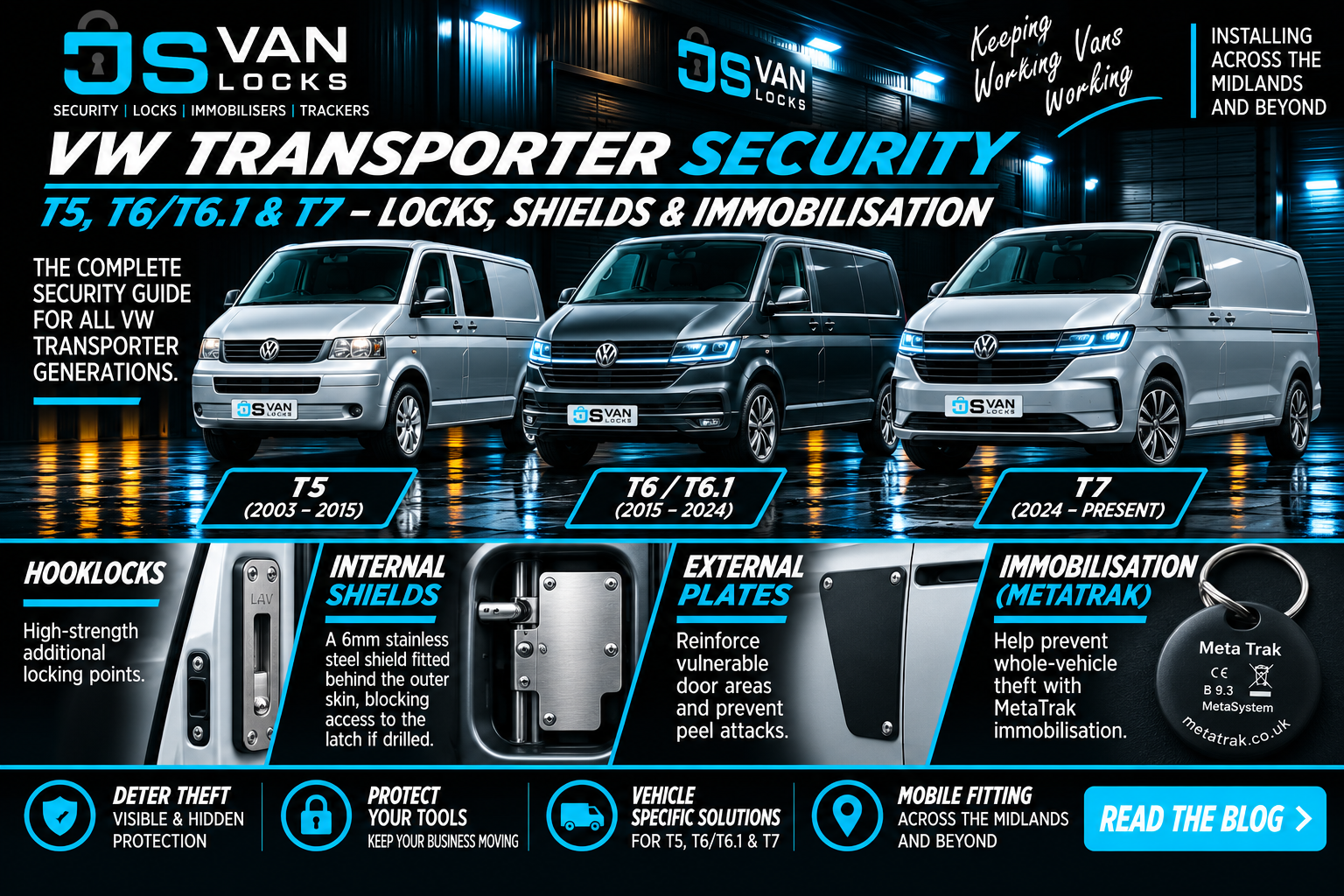
VW Transporter Security: T5, T6/T6.1 & T7 Locks, Shields & Immobilisation

The Volkswagen Transporter has earned a strong reputation as a work van, camper base and premium commercial vehicle. That does not mean every generation needs the same security package.
A T5 carrying tools, a T6.1 camper conversion and a new T7 panel van can have completely different priorities. At JS Van Locks, we treat Volkswagen factory security as a solid starting point, then add protection where the vehicle, contents and customer’s routine justify it.
For most tool-carrying Transporters, that means assessing additional loading-door locks first, then shielding, anti-peel protection and whole-vehicle immobilisation where appropriate.
Which VW Transporter do you own?
The current Locks 4 Vans range separates the Transporter into four fitment generations:
Transporter T5: 2003–2014.
Transporter T6: 2015–2020.
Transporter T6.1: 2020 onwards, including supported electric and hybrid variants.
Transporter T7: 2024 onwards.
The T6 and T6.1 share a lot visually, but the available security products and exact fitting kits are not identical. The T7 is a separate generation again, so we confirm the vehicle before ordering parts.
Transporter T5: strong load-door protection without overcomplicating it
The T5 remains a very popular work van and camper base. We would not describe its factory security as poor, but additional loading-door security can still make sense when the van carries tools, equipment or a valuable conversion.
Locks 4 Vans’ T5 fitment guide recommends a high-position hooklock on the sliding side door and a high-position hooklock on suitable rear barn doors. High and low side-door positions are available, with high, mid and low options on the rear barn doors.
The same guide lists internal latch shields for the nearside and offside sliding doors, plus a shielding kit that combines an external shield with a drill-resistant internal plate on the sliding doors.
For a tradesperson carrying tools, our starting point would usually be suitable hooklocks on the loading doors, then shielding if the vulnerable latch area needs additional protection.
For a T5 camper or high-value conversion, we would also give more attention to whole-vehicle theft protection and tracking because the vehicle itself may represent a much larger investment than an ordinary work van.
Transporter T6 2015–2020: layered door security plus stronger whole-vehicle protection
The T6 keeps the same basic idea of independent loading-door security, but we give greater weight to protecting the whole vehicle as well as the contents.
L4V’s T6 fitment guide recommends high-position hooklocks on the side load door and rear barn doors. It also lists internal latch shields for both sliding doors and a combined external shield and drill-resistant internal plate for the side doors.
That combination matters because hooklocks and shields do different jobs. A hooklock adds another independent locking point. Shielding protects selected factory mechanisms behind or around the outer door skin.
If the van is used as a camper, carries expensive kit or spends nights parked away from home, we would normally discuss additional immobilisation rather than relying on physical door security alone.
Transporter T6.1 2020 onwards: hooklocks, shielding and anti-peel protection
The T6.1 is one of the most common Transporters we see for both trade and leisure use. L4V’s T6.1 security guide recommends a high-position hooklock on the side load door and a high-position hooklock on the rear barn doors.
For door-mechanism protection, the current guide lists an internal latch shield for the barn door, plus a side-door shielding kit combining an external shield with a drill-resistant internal plate.
L4V also lists anti-peel protection for the nearside and offside sliding doors, available in high and low positions. The manufacturer recommends using it with a high-position hooklock on the same door where compatible.
For a working T6.1, that gives us several distinct layers to choose from: independent hooklocks, latch or drilling protection, anti-peel reinforcement and whole-vehicle immobilisation.
Transporter T7 2024 onwards: treat it as a separate vehicle
The T7 is not simply a facelifted T6.1. It has its own fitting range and compatibility rules, so we assess it separately.
L4V’s T7 fitment guide recommends a high-position hooklock on the side load door and a mid-position hooklock on the rear barn doors.
The reason the rear recommendation changes matters: the T7 has its own door layout and product compatibility. L4V specifically notes that the mid-position rear hooklock is not compatible with the barn-door handle shield.
For glazed doors, the fitting positions also change. L4V lists the low side-door hooklock as suitable for glazed doors, while high positions are not suitable for glazing. Rear mid and low positions are listed as suitable for glazed barn doors.
The current T7 range also includes side-door anti-peel protection, a combined external shield and drill-resistant internal plate for the sliding doors, slamlocks for suitable delivery use and an OBD guard.
We do not automatically push extra cab-door locks on every T7. For a normal panel van, the load area and whole-vehicle theft risk are usually the first priorities. Camper conversions without a solid bulkhead are assessed differently because the cab can become an access route into the living space.
Why hooklocks are usually our starting point for tool-carrying Transporters
An L4V hooklock is a mechanical deadlock operating independently from the VW central locking system. Its hook-shaped bolt engages with a receiving section and is operated by a dedicated high-security key.
For an owner-driver who will use the locks consistently, that independence is valuable. Even if the factory locking is released, an engaged hooklock remains a separate physical barrier.
Our hooklock product page shows the current fitted options and key systems. The exact number and positions depend on the vehicle, doors and glazing.
Internal shielding: protecting the factory latch behind the outer skin
A common reason for fitting internal shielding is to protect the original door latch from access through the outer door skin.
The principle is straightforward: the factory latch should not be sitting directly behind a vulnerable skin with nothing substantial between it and the outside world. Vehicle-specific shielding adds a protective layer around the mechanism so puncturing the outer panel does not automatically provide the access needed to operate the latch.
The exact material, thickness and mounting arrangement depend on the kit. The illustration in our cover explains the principle rather than representing one universal Transporter shield.
External plates: visible reinforcement where the kit requires it
External plates add protection over selected vulnerable areas of the door and also provide a visible deterrent.
Our external shielding range can be used preventively, not only after a break-in. On some Transporters, L4V uses a combined solution with an external shield and an internal drill-resistant plate.
We generally favour discreet internal protection when it solves the problem cleanly, but we use external plates where the correct vehicle-specific kit or the customer’s circumstances call for them.
What about anti-peel protection?
Door peeling is a different attack from accessing the latch through the door skin. Anti-peel hardware reinforces the edge of the sliding door against being pulled or bent away from the body.
On compatible T6.1 and T7 vans, L4V recommends pairing the anti-peel kit with a high-position hooklock on the same sliding door. The two products do related but different jobs.
Should a Transporter have an immobiliser?
Physical door security protects the contents. It does not stop someone from driving away the whole van.
For T6, T6.1 and T7 vehicles, and for campers or high-value T5 conversions, we normally give whole-vehicle theft protection serious consideration.
MetaTrak AutoBlock adds driver authorisation without GPS tracking or an ongoing tracking subscription. It is useful where the priority is preventing unauthorised starting.
Where the customer also wants monitored tracking and stolen-vehicle recovery support, MetaTrak S5 Deadlock combines S5 tracking, driver recognition and immobilisation.
Neither system physically secures the loading doors, which is why electronic and mechanical protection are best viewed as separate layers.
What would JS Van Locks recommend for a working Transporter?
The final setup depends on generation, doors, glazing and how the van is used, but our starting point is usually:
Suitable additional loading-door locks for a tool-carrying van.
High-position hooklocks where the generation and glazing allow them.
Internal or combined shielding where the factory latch or mechanism needs protection.
Anti-peel reinforcement on compatible T6.1 and T7 sliding doors when peeling is a concern.
Immobilisation or tracking when whole-vehicle theft is also a priority.
We also ask whether the van has barn doors or a tailgate, one or two sliding doors, glazing, racking, a camper conversion, existing security or previous attack damage.
Transporter campervans: does the cab need extra locks?
For a camper or leisure conversion, the bulkhead changes the recommendation.
If there is no solid bulkhead between the cab and living area, the cab doors can become another route into the conversion, so cab-door security deserves more attention.
If a strong solid bulkhead separates the cab from the living area, we do not automatically push extra cab locks. We focus first on the doors that actually provide access to the valuable space.
For higher-value campers, immobilisation and tracking are also worth discussing even when the physical door security is already strong.
How much does VW Transporter security cost?
The total depends on the generation, number of doors, lock positions, shielding, anti-peel protection and any immobiliser or tracker.
Our van-security cost guide contains the current VAT-inclusive JS Van Locks prices and example packages.
A useful quote should clearly state which doors are covered, which products are being fitted, whether the price includes VAT and fitting, and any ongoing subscription charges for tracking.
Frequently asked questions
Do T5, T6, T6.1 and T7 Transporters use the same lock kits?
No. The generations have different fitment ranges and compatibility rules. We confirm the exact vehicle before ordering parts.
Are high-position hooklocks always the best choice?
No. High positions are often recommended, but glazing and generation-specific restrictions matter. The T7, for example, uses a mid-position rear recommendation and has different glazed-door options.
Does a hooklock replace shielding?
No. A hooklock adds an independent locking point; shielding protects selected factory mechanisms and vulnerable areas.
Does every Transporter need an immobiliser?
No. We weigh the vehicle’s generation, value, use and theft risk. We give stronger weight to immobilisation on T6/T6.1/T7 vehicles, high-value campers and vans where whole-vehicle theft is a major concern.
Can you secure a glazed Transporter?
Yes, but glazing affects which lock positions are suitable. We check the specific doors before confirming the fitting plan.
Mobile VW Transporter security fitting across the Midlands
JS Van Locks provides mobile van-security installation across the Midlands, including Leicester, Derby, Swadlincote, Burton upon Trent, Tamworth and surrounding areas, with wider travel available for suitable jobs and fleet work.
Send your registration, fitting postcode, door layout, existing security and what you want to protect. Photos are useful for camper conversions, glazing, racking and previous damage.
For a broader overview of layered protection, see our Midlands van-security guide, or read our internal vs external shielding guide for more detail on protecting factory latch mechanisms.
No security product guarantees that a vehicle cannot be broken into or stolen. Product availability and fitment can change, so the final specification is confirmed for the individual Transporter before installation.


Comments