
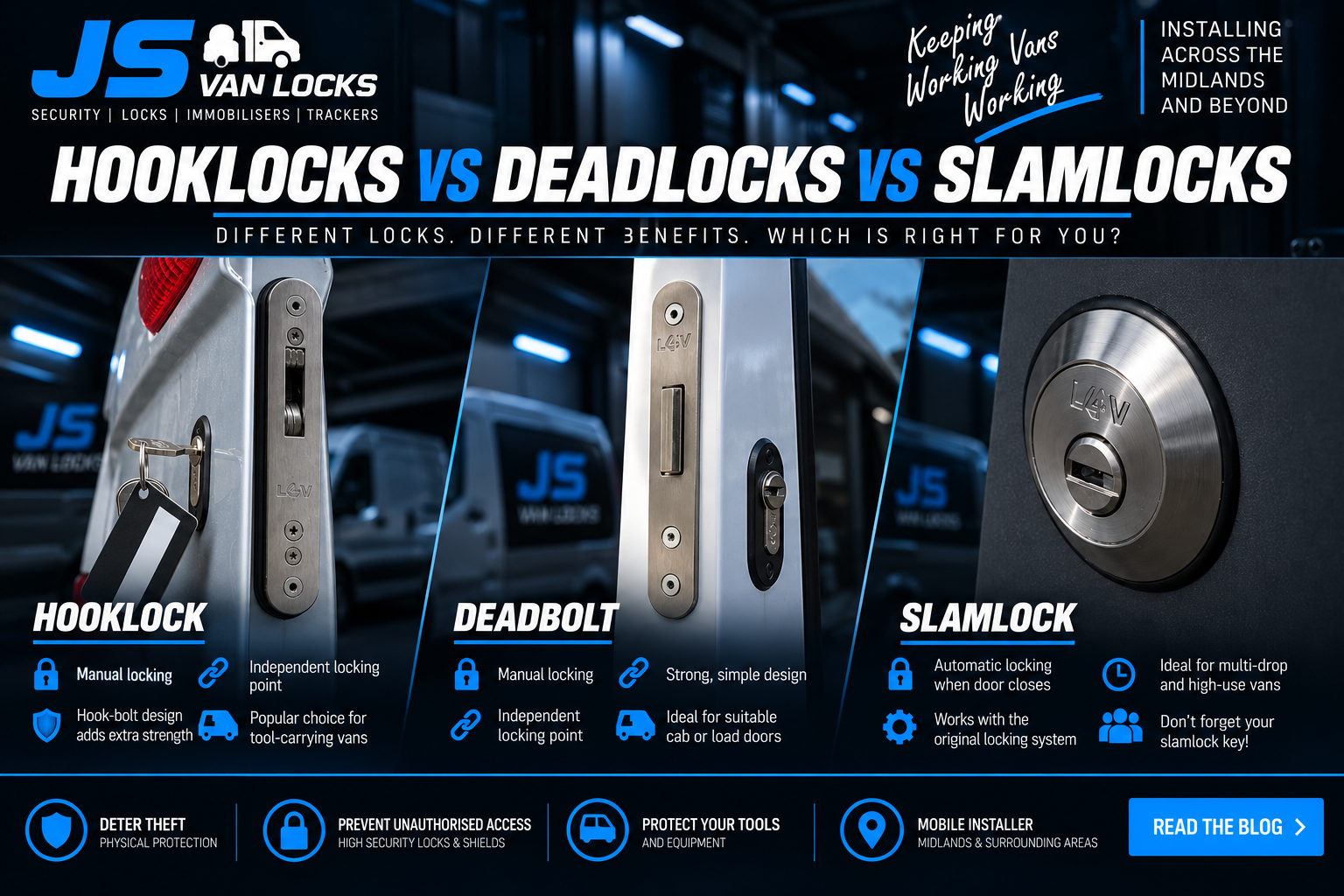
Hooklocks vs Deadlocks vs Slamlocks: Which Van Locks Are Right for You?

Choosing additional van locks can be confusing. Hooklocks, deadlocks and slamlocks are often mentioned together, but they do not all work in the same way.
The right choice depends on your vehicle, what you carry and how you use the doors throughout the day.
At JS Van Locks, we start with a practical question:
What needs protecting, and which locking system will work reliably with your daily routine?
This guide explains the differences, where each option can make sense, and why the correct installation matters just as much as the name on the box.
What is the difference between hooklocks, deadlocks and slamlocks?
First, an important distinction: a hooklock is itself a type of mechanical deadlock.
When people compare “hooklocks versus deadlocks”, they usually mean a hook-bolt lock versus a conventional straight-bolt deadlock. Both L4V systems operate independently of the vehicle’s original locking system and require the driver to engage them manually. See L4V’s hooklock description.
A slamlock addresses a different issue: it automatically locks the door when it closes. L4V’s slamlock integrates with the original locking system and requires its dedicated key to reopen the door from outside. See L4V’s slamlock description.
Feature | Hooklock | Conventional deadlock | Slamlock |
How it secures the door | A hook-shaped bolt engages with a receiving section | A straight bolt engages with a receiving section | Integrates with the original locking system to provide automatic locking |
How it is locked | Manually, using its key | Manually, using its key | Automatically when the door closes |
Separate locking point from the factory system? | Yes | Yes | Not the same independent-bolt arrangement |
Main practical consideration | The driver must engage it | The driver must engage it | Keep the dedicated key with you before closing the door |
This comparison describes the L4V systems discussed in this guide. Exact suitability depends on the vehicle, door and selected fitting kit.
What is a van hooklock?
A hooklock adds an independent mechanical locking point. Instead of relying solely on the factory latch, its hooked bolt secures the door to a receiving section.
L4V recommends hooklocks for owner-drivers and other situations where the driver can be relied upon to operate them. Its kits are vehicle-specific. See the manufacturer’s hooklock information.
For a tradesperson who controls access to their own van, our usual starting point is to assess suitable hooklocks for the loading doors.
The essential part is the locking routine. A manually operated lock left disengaged cannot provide its intended additional barrier. We would discuss when you access the van and how you will use the locks, rather than assume that fitting them is the whole job.
Explore our Locks 4 Vans hooklocks and the available fitting options.
What is a conventional van deadlock?
A conventional deadlock uses a straight bolt rather than a hook-shaped bolt. Like the L4V hooklock, it is operated using an external key and works independently of the factory locking system.
L4V recommends its straight-bolt deadlock for suitable cab-door applications and may specify it as an alternative where a hooklock is not appropriate. See L4V’s deadlock specification.
That does not mean every cab door needs a straight-bolt deadlock, or that a hooklock is automatically the right choice everywhere else.
At JS Van Locks, we assess the complete installation: the door, the receiving section, available space, existing equipment and the protection required.
The decision should be based on the actual vehicle, not a blanket claim that one bolt shape is always best.
What is a van slamlock?
A slamlock locks automatically when the door closes. That makes it particularly relevant to repeated loading-area access.
L4V primarily designs its slamlocks for couriers, multi-drop delivery drivers and similar operations where forgetting to relock a door is a concern. See the manufacturer’s slamlock information.
For those customers, we would discuss slamlocks because they remove a separate manual locking step after each stop.
However, automatic locking changes the key-management routine too.
Make sure the slamlock key is with you before closing the door. Leaving it in the loading area can leave you locked out. We explain everyday operation at handover and recommend keeping a spare somewhere secure outside the locked van.
View our Locks 4 Vans slamlocks for the product and compatibility information.
Which van locks would JS Van Locks recommend?
These are starting points for an assessment, not fixed packages for every customer.
Tradespeople carrying tools
For electricians, plumbers, builders, carpenters and other tool-carrying trades, suitable additional loading-door locks are our baseline recommendation.
For an owner-driver who will operate them consistently, we would normally begin by assessing hooklocks, then consider shielding and anti-peel protection where appropriate.
We would not reduce that recommendation simply because the van is older. What you carry and how much you rely on the vehicle matter alongside its value.
If your work involves constant access and remembering to lock manually is a concern, tell us. Your occupation alone does not decide which system will suit you.
Couriers and multi-drop delivery drivers
For a van whose loading doors are opened repeatedly between short stops, we would discuss slamlocks early in the assessment.
The questions would include which doors are used, whether several drivers share the vehicle, and how the dedicated keys will be managed.
We would also assess the door’s physical protection separately. Automatic locking is a useful operating feature, not a complete answer to every possible attack.
Fleets with several drivers
For a fleet, we would look at both vehicle security and the consistency of the operating routine.
That means considering driver handovers, spare keys, existing security, installation scheduling and who needs access to which vehicles.
L4V offers keyed-alike vehicle sets and, within its T-Series range, master-key arrangements that can retain individual vehicle keys while providing authorised fleet-manager access. The appropriate configuration needs discussing before ordering. See L4V’s key-system options.
We would not automatically put every vehicle on the same key. Convenience and the consequences of a lost key both deserve consideration.
Campervans and leisure vehicles
A campervan needs a different assessment from an unattended working van because people may be inside.
We consider glazing, the conversion layout and whether a solid bulkhead separates the cab from the living area. An open walkthrough increases the importance we give to cab-door security.
Any locking arrangement used while occupied must preserve a quick, usable escape route. Do not lock people inside using a system that requires an external key to release their only exit.
Tell us whether the protection is intended for parking the van empty, sleeping inside it, or both. Those are different requirements.
Can every lock fit every door?
No. Vehicle generation, door construction, glazing and existing security can all affect the available combinations.
One useful example is the Ford Transit Custom 2012–2023. L4V states that its rear internal latch shield for that model does not fit with a slamlock. The same guide also places restrictions on certain lock positions when the rear doors are glazed. See the L4V Transit Custom 2012–2023 guide.
This is why we ask about equipment already fitted before recommending another product.
A sliding door, a pair of rear barn doors and a lifting tailgate should not be treated as interchangeable. We also need to know whether racking or a conversion affects access for fitting.
Read our guide to high, mid and low van-lock positions for more detail.
Do additional locks stop door peeling and drilling attacks?
Additional locks are one part of the assessment. The vulnerable door areas and factory mechanisms need attention too.
Door peeling
Peeling involves forcing part of the door away to create access.
An appropriately positioned hooklock adds restraint, while an anti-peel kit reinforces the door edge. L4V recommends combining its side-door anti-peel protection with a suitable high-position hooklock on compatible installations. They perform related but different jobs. See L4V’s anti-peel guidance.
We assess anti-peel protection alongside the lock positions rather than assume a lock alone covers every part of the door.
Drilling or puncturing the outer door skin
Some attacks target access to the original latch or release mechanism through the outer panel.
Vehicle-specific shielding helps protect selected vulnerable areas. It is different from adding another locking point, and the correct product depends on the door and mechanism being protected. See the L4V shielding range.
Our assessment may include internal latch shielding or external shielding.
We generally favour suitable internal protection where it addresses the concern. External plates can also have a preventive role, cover previous attack damage where appropriate, or form part of the required vehicle-specific solution.
A hooklock does not make the outer door skin drill-proof, and a shield is not a substitute for assessing the whole locking arrangement.
Is a Replock the same as a deadlock?
No. A Replock upgrades the original driver’s-door cylinder and bezel on compatible Ford vans. It does not add the same separate locking point as a loading-door hooklock or straight-bolt deadlock.
That means it addresses a different part of the vehicle’s security.
Our L4V Replock product page explains the supported Ford models. For an earlier Transit Custom, we give that driver’s-door upgrade strong priority alongside suitable loading-door locks; the newer generation receives a separate assessment.
Can the additional locks work with the same key?
Compatible L4V locks can be supplied in keyed-alike sets, allowing the locks within that set to use one key. This does not mean they use your original vehicle key.
Tell us about any existing L4V locks before ordering so we can check the key system and available options. L4V’s key ranges and master-key arrangements are not all interchangeable. See L4V’s key-system information.
Keep key-registration information secure, and avoid posting photographs that expose key codes or detailed key blades.
Do I still need an immobiliser?
Door locks and immobilisation address different concerns.
An additional immobiliser such as MetaTrak AutoBlock adds driver authorisation against unauthorised starting. It does not physically secure the loading doors, and the standalone AutoBlock is not a GPS tracker.
For a practical example of combining protection, read our 2026 Ford Transit installation in Leicester. That customer’s requirements led us to fit high-position hooklocks, external latch shields and AutoBlock rather than rely on one product.
No combination guarantees that a van cannot be stolen. The aim is to address the relevant risks with products that work together.
How much do hooklocks, deadlocks and slamlocks cost?
Compare the complete installation, not just a headline price.
The quotation should identify the products, number of locks, doors covered, fitting positions and any accompanying protection. Keying requirements and existing equipment should also be discussed.
Our van-security cost guide includes VAT-inclusive prices and example combinations.
For a conventional deadlock installation or a package involving several products, request a vehicle-specific quotation rather than assume that the hooklock or slamlock price covers the same work.
Choosing van security that suits your working day
Our approach is straightforward: choose compatible protection, make sure the locking routine suits the driver, and assess the rest of the vehicle rather than stop at the first lock.
For a tool-carrying owner-driver, that often starts with suitable hooklocks. For repeated delivery stops, slamlocks deserve consideration. Straight-bolt deadlocks remain relevant where the vehicle and fitting position call for them.
JS Van Locks provides mobile van-security fitting across the Midlands, including Leicester, Derby, Swadlincote, Burton upon Trent and Tamworth.
Send your registration, fitting postcode, door layout, existing security and how you use the van. We will help you choose a suitable arrangement without assuming every customer needs the same package.


Comments