
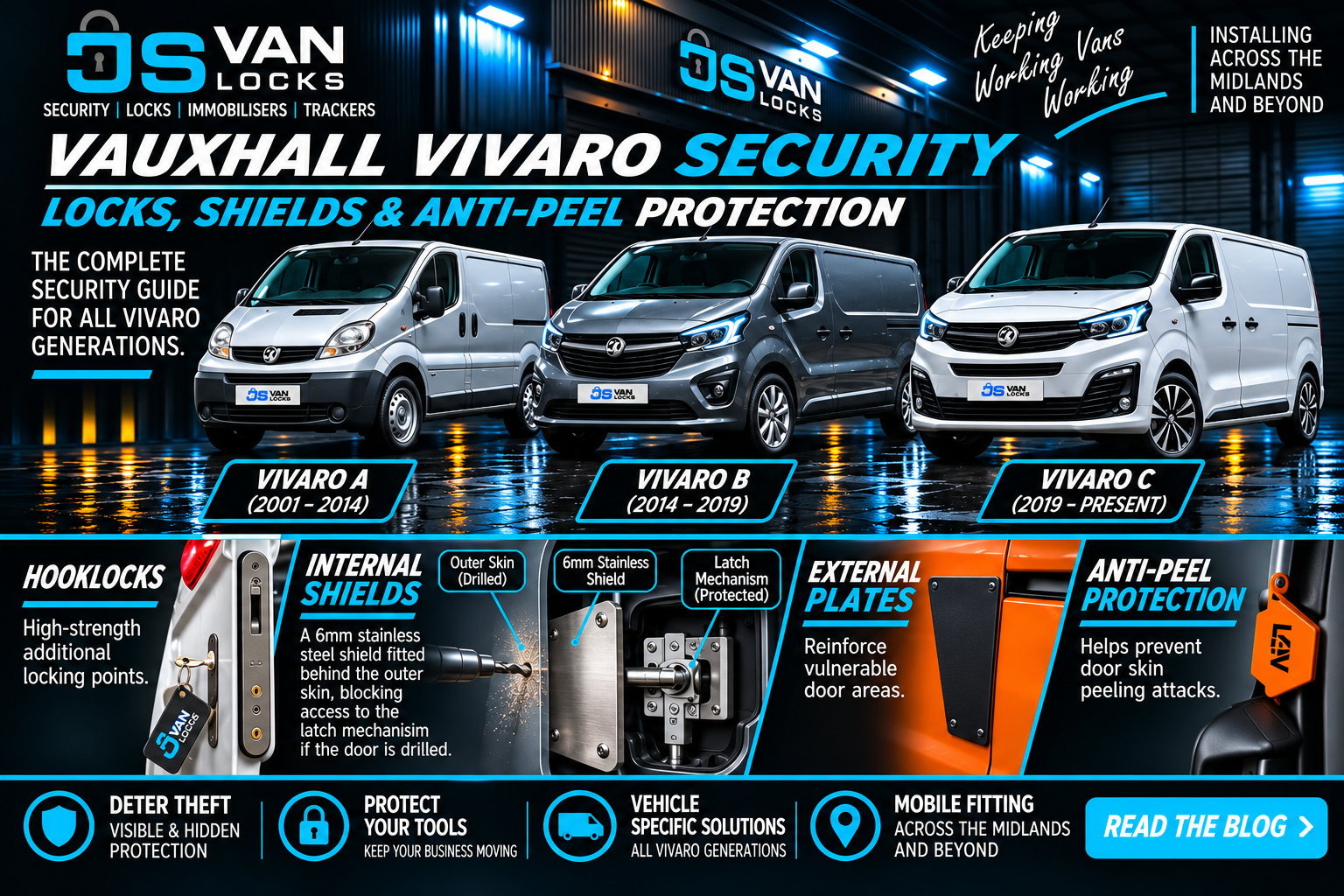
Vauxhall Vivaro Security: Locks, Shields & Anti-Peel Protection
Updated: Nov 14

The Vauxhall Vivaro has been one of the UK’s most popular working vans for years, but the right security setup depends heavily on which generation you own and how the van is used.
A Vivaro carrying tools, equipment or stock needs more than a generic “fit two locks” answer. Door design, vulnerable latch areas, peeling risk, glazing, existing security and whole-vehicle theft all need to be considered together.
At JS Van Locks, our usual approach is layered: suitable additional locks for the loading doors, protection around vulnerable factory mechanisms, anti-peel reinforcement where appropriate, and immobilisation when preventing the whole vehicle from being driven away is also a priority.
Which Vauxhall Vivaro do you own?
For security purposes, it is useful to separate the Vivaro into three generations:
Vivaro A: 2001–2014.
Vivaro B: the second-generation van introduced in 2014 and replaced at the 2019 model change. Locks 4 Vans’ current fitment page is titled 2014–2018, so we confirm the exact vehicle before ordering parts.
Vivaro C: 2019 onwards, including supported electric and hybrid variants.
Registration year alone is not always enough around a model change. Send us your registration and, if needed, a photograph of the van so we can identify the correct kit.
Vivaro A 2001–2014: strong physical security is worth prioritising
The first-generation Vivaro is an older design, but we do not reduce a recommendation simply because the van is older. If it carries the tools you rely on for work, protecting the loading area still matters.
L4V’s current Vivaro 2001–2014 fitment guide lists high and low side-door positions, with high, mid and low options on low-roof rear barn doors. It recommends a high-position hooklock on the sliding side door and a high-position hooklock on suitable rear barn doors. On high-roof rear doors, L4V notes that a hooklock is not available and offers a straight-bolt deadlock alternative.
For a tool-carrying Vivaro A, we would normally start by assessing suitable hooklocks on the loading doors, then look at shielding or external protection where the door mechanism is vulnerable.
Cab-door locks are not an automatic baseline for every trade van. If the vehicle is a camper, has no solid bulkhead or the cab gives direct access to the load area, cab security becomes more important.
Vivaro B: hooklocks, shielding and anti-peel protection
The second-generation Vivaro benefits from a more vehicle-specific layered approach. L4V’s current Vivaro B fitment guide lists high and low side-door hooklock positions and high, mid and low rear positions, with a high-position side and rear hooklock recommended where suitable.
This generation is also well served by shielding products. L4V lists internal latch shields to protect selected mechanisms against access through the outer door skin, along with a shielding kit that can combine an external shield with a drill-resistant internal plate on the sliding doors.
That distinction matters. A hooklock adds an independent locking point; it does not make the whole door skin resistant to drilling or puncturing. Shielding protects a different part of the door.
For Vivaro B vans where door peeling is a concern, we would also discuss anti-peel protection. L4V recommends its anti-peel kit with a high-position hooklock on the rear edge of the same sliding side door, subject to compatibility.
Vivaro C 2019 onwards: build the security around the door layout
For the 2019-on Vivaro, L4V’s current vehicle guide recommends a high-position hooklock on the side load door and a high-position hooklock on the rear barn doors. A low side-door hooklock is also listed for suitable short-wheelbase vans.
The same guide lists anti-peel protection for both nearside and offside sliding doors, as well as a shielding kit combining an external shield with a drill-resistant internal plate on the sliding doors. Handle shields and a rear-door loom guard are also listed for relevant attack areas.
That makes the 2019-on Vivaro a good example of why ‘one lock per door’ is not the same as a full security assessment. The factory latch, outer skin, upper door edge and vehicle itself can all need different types of protection.
Why we often recommend high-position hooklocks
A high-position L4V hooklock adds another mechanical locking point towards the upper part of the door. The hooked bolt engages with its receiving section independently of the van’s central locking.
On compatible Vivaro installations, positioning the lock high also helps provide restraint higher up the door, which is particularly useful when the concern includes the upper section of a sliding or rear door being forced away.
The exact position still depends on the generation, door, glazing and fitting kit. We do not copy a position from one Vivaro onto another without checking compatibility.
Internal shielding: protecting the latch behind the outer skin
A common reason for fitting internal latch shielding is to protect the original latch mechanism from access through the outer door skin.
The principle is simple: the outer panel is not the only layer between the outside of the van and the latch. A heavy stainless shield is fitted behind the skin around the vulnerable mechanism, so puncturing the outer metal does not automatically provide the access needed to operate the latch.
Our cover illustration shows this principle using a substantial stainless layer between the outer skin and latch. The exact shield shape, material thickness and mounting arrangement vary by vehicle and product, so the final fitted part is always vehicle-specific.
Internal protection is usually our preferred approach where it addresses the vulnerable area cleanly and keeps the outside of the van looking standard.
External plates: visible protection over vulnerable areas
External security plates perform a related but different job. They are fitted over selected areas of the outer door skin to add visible protection and make puncture or drilling attacks harder.
Our external shielding range includes vehicle-specific plates in different finishes where available.
External plates are not only for repairing previous damage. They can be fitted preventively, and they also act as a clear visual sign that the door has additional protection.
We may prioritise them where the correct kit uses an external component, when a customer wants visible reinforcement, or where previous attack damage has been properly repaired and a plate is suitable to cover and strengthen the area.
Anti-peel protection: reinforcing the edge of the sliding door
Peel-and-steal attacks involve forcing or bending part of the door away from the body to create an opening.
An L4V anti-peel kit reinforces the vulnerable edge of the sliding door and engages when the door closes. It is a physical strengthening product, not an alarm sensor.
On compatible Vivaro installations, we would normally consider anti-peel protection alongside a high-position hooklock rather than treat the two products as alternatives. The hooklock adds another locking point; the anti-peel hardware reinforces the door edge.
Do shields replace hooklocks?
No. They protect different parts of the security system.
Hooklocks add independent mechanical locking points.
Internal shields protect selected factory mechanisms behind the door skin.
External plates reinforce vulnerable exterior areas and provide a visible deterrent.
Anti-peel kits reinforce vulnerable door edges against peeling attacks.
A layered setup uses each product for the job it is designed to do rather than expecting one component to solve every attack method.
Our internal vs external shielding guide explains the difference between plates and internal shields in more detail.
Should a Vivaro also have an immobiliser?
Door security protects access to the van. It does not stop the whole vehicle being driven away.
If whole-vehicle theft is also a concern, we would discuss additional immobilisation such as MetaTrak AutoBlock where compatible. AutoBlock adds driver authorisation against unauthorised starting and does not replace the physical loading-door security described above.
For a working van carrying valuable tools, combining physical door protection with whole-vehicle protection can make more sense than choosing one or the other.
What would JS Van Locks recommend for a tradesperson’s Vivaro?
The exact answer depends on the generation and door layout, but our starting point is usually:
Suitable additional locks on the loading doors.
Internal shielding around known vulnerable factory mechanisms where compatible.
High-position hooklocks and anti-peel reinforcement where peeling is a concern.
External plates where the correct vehicle-specific solution or customer requirement calls for them.
Immobilisation when preventing whole-vehicle theft is also a priority.
We would also ask whether the van has one or two sliding doors, barn doors or a tailgate, windows, racking, a camper conversion, existing locks, or previous break-in damage.
If several people drive the van or the vehicle is used for frequent deliveries, the locking routine matters too. Our hooklocks vs deadlocks vs slamlocks guide explains the practical differences.
How much does Vivaro security cost?
The price depends on the number of doors, the chosen locking positions, shielding, anti-peel protection and any electronic security added.
Rather than duplicate prices here and risk them going stale, our van-security cost guide contains the current VAT-inclusive JS Van Locks prices and example packages.
A useful quotation should clearly state which doors and positions are covered, which products are supplied, fitting, VAT, any travel charges and any subscription costs for tracking products.
Frequently asked questions
Is the Vivaro A too old to justify additional security?
No. We base the recommendation on what you carry and how much you rely on the van, not its age alone.
Can I fit hooklocks without shields?
Yes, where the hooklock kit is suitable, but the hooklock and shield protect different vulnerabilities. We assess whether the factory latch or outer skin also needs protection.
Does every Vivaro need anti-peel protection?
No. It depends on the generation, door design, compatible products and the customer’s priorities. Where peeling is a concern and a compatible kit exists, we often pair anti-peel protection with a high-position hooklock.
Can external plates be fitted before the van is attacked?
Yes. External plates can be used preventively as visible protection; they are not limited to covering previous damage.
Do you fit security to electric Vivaro models?
L4V’s current 2019-on Vivaro guide includes supported electric and hybrid variants. We still confirm the exact vehicle and product compatibility before booking.
Mobile Vauxhall Vivaro security fitting across the Midlands
JS Van Locks provides mobile van-security installation across the Midlands, including Leicester, Derby, Swadlincote, Burton upon Trent, Tamworth and surrounding areas, with wider travel available for suitable jobs and fleet work.
For a quote, send your registration, fitting postcode, door layout, existing security and what you need to protect. Photos are especially useful where the van has glazing, racking, a conversion or previous damage.
For a broader overview of layered protection, see our Midlands van-security guide.
No security product guarantees that a vehicle cannot be broken into or stolen. Product availability and fitment can change, so the final specification is confirmed for the individual van before installation.


Comments