
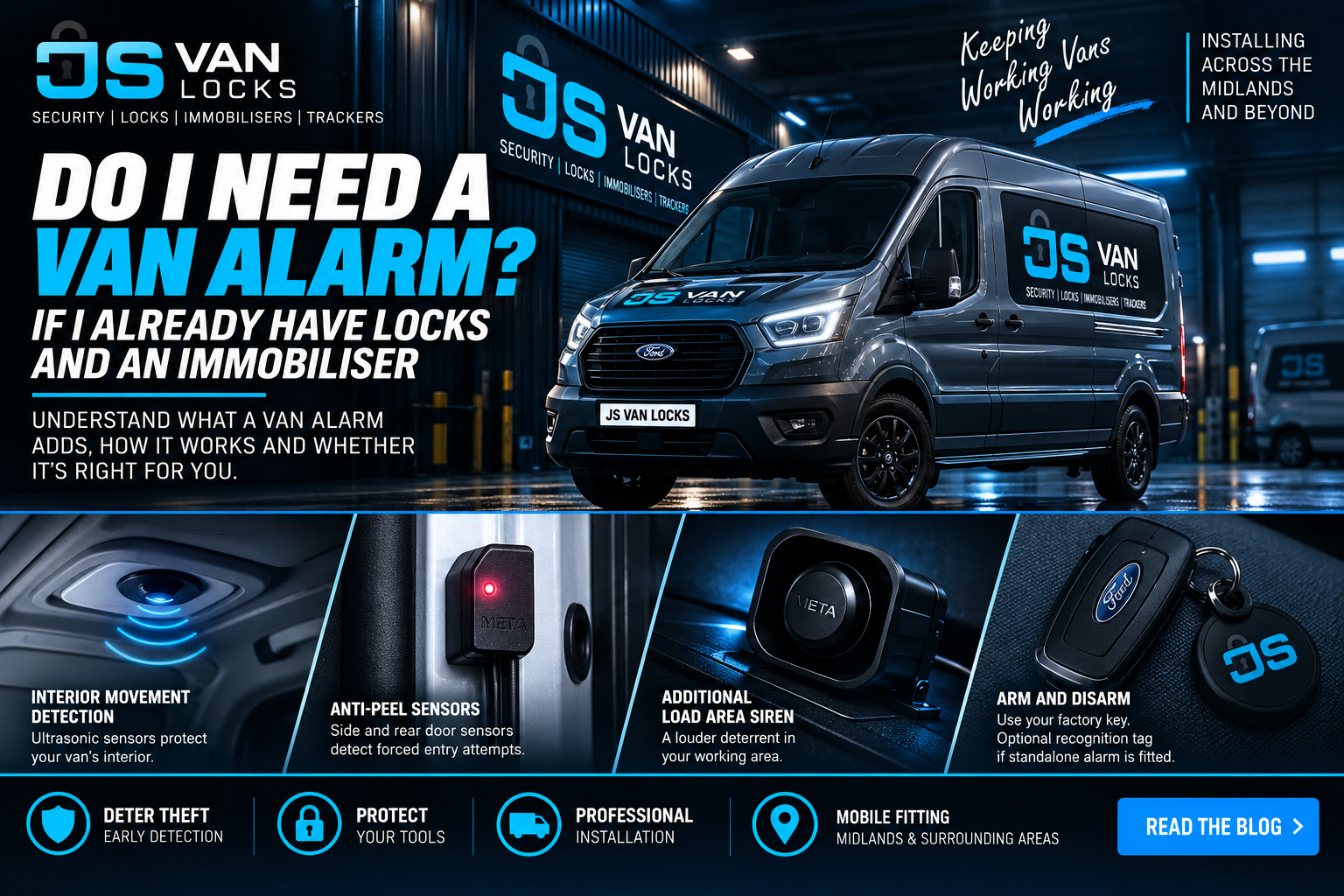
Do I Need a Van Alarm If I Already Have Locks and an Immobiliser?

Additional locks make your van harder to enter. An immobiliser helps prevent unauthorised starting. But what would alert you if someone attempted a break-in?
That is where a suitable van alarm can add another layer of protection.
An alarm does not replace your locks or automatically make an immobiliser unnecessary. It adds detection and warning to the security already fitted.
At JS Van Locks, we assess what your van carries, how it is used and where it is parked before recommending a system. Our van-alarm installation package combines an alarm upgrade with additional loading-area protection, rather than treating every working van as an ordinary car.
This guide explains what that package includes, what costs extra and what you need to consider before booking.
Locks, alarms, immobilisers and trackers: what does each one do?
It helps to think about the different jobs your security needs to perform.
Security layer | Its main purpose |
Additional locks and physical protection | Make access harder and reinforce selected vulnerable areas. |
Alarm | Detect monitored events and provide an audible warning, with remote notifications available through suitable connected arrangements. |
Immobiliser | Add authorisation against unauthorised starting or driving, depending on the system. |
Tracker | Provide vehicle-location information and, with an appropriate monitored service, support stolen-vehicle recovery. |
Some products combine functions. For example, MetaTrak S5 Deadlock combines tracking, driver recognition and immobilisation. That does not mean it physically locks the loading doors or automatically provides every alarm sensor your van might need.
The right question is therefore not simply, “Have I already bought security?” It is: “Which risks does my existing setup address, and what remains uncovered?”
What does a van alarm add to existing locks?
For a working van, our aim is to combine physical resistance with detection.
A hooklock can provide an additional locking point. Shielding can protect selected vulnerable areas. An alarm can add a warning when one of its monitored sensors or inputs is triggered.
However, an alarm only detects the events covered by its installed and configured system. We would not promise that every scrape, drilled hole or attempted attack will automatically trigger it.
This is why we assess the loading area, door layout and existing security rather than assume that fitting an alarm control unit is the whole job.
Our hooklocks, deadlocks and slamlocks guide explains the physical-locking options that can sit alongside an alarm.
What can the Meta EVO CAN alarm detect?
The Meta Trak EVO CAN alarm combines factory door-opening and ignition monitoring with ultrasonic interior sensing, tilt detection and optional additional sensors. On compatible vehicles it integrates with the existing CAN-bus or supported LIN-bus system. The available signals and coverage are confirmed for your vehicle.
Door opening through the vehicle’s built-in electronics
On supported vans, the alarm can use door-opening signals already present in the vehicle's electronics, rather than relying only on separate added sensors. With compatible CAN-bus integration, this can include the cab and loading doors. If a monitored door opens while the alarm remains armed, it can trigger the alarm. Where a required signal is not available digitally, suitable wired inputs or additional sensors may be needed.
The installation needs to account for the doors and access points you want protected.
Tell us whether the van has one or two sliding doors, rear barn doors or a tailgate. We also need to know about existing equipment, body conversions and any additional compartments.
Do not assume that every opening on a modified vehicle is monitored simply because an alarm is fitted.
Switching the ignition on while the alarm is armed
The system also monitors the ignition signal. Switching the ignition on while the alarm remains armed can trigger an alarm. This is separate from interior movement detection and does not require the vehicle to move first. The response depends on the installed configuration.
Manufacturer references: Meta EVO CAN product overview and Meta System’s EVO CAN installation manual, covering vehicle-network integration, perimeter protection and ignition-attempt monitoring.
Movement inside the vehicle
Ultrasonic sensors detect movement within the area they cover.
For a working van, we would assess the cab and loading area separately. A bulkhead, racking or conversion means we should not assume that sensors protecting one space also cover another.
Changes in vehicle angle
The EVO CAN system includes tilt detection, which can identify changes in vehicle angle associated with events such as jacking or some towing attempts. That is detection, not a physical barrier against lifting the vehicle.
Door-peeling movement
Our van package adds dedicated side- and rear-door anti-peel sensors. Their purpose is to provide alarm detection associated with movement at those protected door areas.
The fitting and positioning need to suit the actual doors. We explain the coverage as part of the installation rather than promise that one sensor detects every possible attack.
An anti-peel sensor is not an anti-peel bracket
This distinction matters when comparing quotations. An anti-peel sensor provides detection. Physical anti-peel reinforcement provides resistance.
A sensor does not strengthen the door metalwork, and a physical bracket does not automatically sound an alarm.
Depending on your van, we may discuss additional locks and compatible physical anti-peel protection alongside the alarm. These are separate products with different jobs.
Buying an alarm package that includes anti-peel sensors does not mean physical anti-peel kits or hooklocks are also included.
What is included in the JS Van Locks van-alarm package?
Our Van Alarm Package is £599 supplied and installed, including VAT. The standard package includes:
Meta EVO CAN 2–1 alarm upgrade.
An additional load-area siren.
One side-door anti-peel sensor and a rear-door anti-peel sensor.
Custom-made sensor brackets, designed and manufactured in-house by JS Van Locks to suit the van.
Professional installation and a fitting certificate.
The load-area siren adds audible warning within the working area of the van. It is not a substitute for locks, and we do not promise that a siren will always be heard from inside a house or hotel.
Why we make vehicle-specific sensor brackets
Different doors and installations need different mounting arrangements.
Our in-house brackets allow us to provide a mounting solution suited to the van rather than rely on one universal arrangement. We confirm the vehicle and door layout before fitting.
This is part of specifying the installation properly, alongside choosing the relevant sensors and checking the existing security.
What is optional, and how much does it cost?
The standard package covers one sliding side door. A second side-door sensor is available for vans with twin sliding doors. We also offer an optional connection to a suitable MetaTrak tracker.
Package configuration | Supplied and installed, including VAT |
Standard van-alarm package | £599 |
Package with an additional sensor for the second sliding door | £674 |
Standard package with a compatible MetaTrak alarm-to-tracker connection | £679 |
Twin-side-door package with the compatible tracker connection | £754 |
These configurations match our current van-alarm package options. The additional side-door sensor costs £75. The alarm-to-tracker connection costs £80.
The connection price does not include a tracker, its installation or a tracking subscription. The suitable tracker must already be fitted or be installed at the same appointment.
For our package, the connection upgrade must be requested when arranging the alarm installation and completed during that installation. Compatibility is checked before fitting.
Additional locks, physical anti-peel reinforcement and shielding are also separate from the alarm-package prices above. An optional recognition-tag arrangement for a standalone alarm is discussed separately; it is not an automatic inclusion in the package table.
Will the alarm notify my phone?
Do not assume that a standalone alarm automatically sends phone notifications.
Our EVO CAN alarm can be integrated with a compatible MetaTrak tracker or S5 Deadlock system. The available app functions and notifications depend on that connected system and its configuration.
MetaTrak’s app supports vehicle-status notifications, including movement and battery-related alerts on suitable systems. That does not mean every alarm input is automatically connected or reported in the same way. See MetaTrak’s app information.
When discussing a connected installation, we would confirm which alarm events can be reported, what tracking service is required and how the notification settings should be configured. You can also view our MetaTrak S7 ATS tracking option; suitability for the proposed alarm connection must be confirmed for the exact system.
Remote notifications also depend on the relevant connectivity and phone settings. They should complement the other security layers, not be treated as a guarantee that every event will reach you immediately.
The standalone MetaTrak AutoBlock is an immobiliser, not a GPS tracker or an app-connectivity upgrade. Having AutoBlock fitted does not, by itself, provide the tracker connection described above.
How does the alarm arm and disarm?
For the factory-key configuration we supply, the alarm arms and disarms using the vehicle’s original remote key. A separate recognition tag is not automatically required.
For a standalone alarm installation, an optional recognition tag can be specified. We confirm the chosen arrangement and explain whether a tag is required for that particular setup before fitting and at handover.
A Ford key is shown in the cover illustration as an example. Vehicle compatibility and the available operating arrangement are checked for your own van. The illustration does not mean a tag is included with every alarm package.
What about stolen keys or electronic unlocking?
How an alarm disarms matters as well as what makes it sound. Do not assume that a factory-key-controlled alarm independently identifies the driver or that an optional tag is fitted as standard.
If stolen-key or electronic-theft protection is a priority, tell us. We will discuss the appropriate authorisation and immobilisation options, including any optional recognition-tag arrangement, rather than promise that the alarm alone covers every method.
We would not describe any system as impossible to bypass or guaranteed to defeat every theft method. If the van already has an immobiliser or another alarm, tell us so we can assess how the proposed equipment will work with it. The objective is a coherent setup, not simply the largest number of security devices.
Is a van alarm worthwhile when working away or staying in hotels?
For customers who regularly park away from home, we would discuss both detection and what happens after an alert.
A van might be parked where you cannot hear its siren clearly. That makes the question of connected notifications particularly relevant, alongside physical locks, suitable parking and whole-vehicle protection.
Our Leicester Ford Transit case study shows why the customer’s routine matters. That customer worked away, stayed in hotels and had experienced previous van thefts and break-ins.
Their installation combined high-position hooklocks, external latch shields and AutoBlock. The case study does not describe an alarm installation. It illustrates how previous incidents and working habits shape the recommendation.
For another customer with similar concerns, we would assess whether alarm detection and a suitable connected setup should also form part of the plan.
If you receive an alert suggesting a theft is in progress, prioritise your safety rather than confronting anyone.
Will the alarm meet my insurer’s requirements?
Our van-alarm package is offered as a Category 2–1 alarm upgrade, designed to meet Category 1 requirements when installed alongside a suitable existing Category 2 immobiliser and when the required installation criteria are met. We check suitability before fitting and provide a fitting certificate.
The terminology is important: Thatcham lists Category 1 for electronic alarm-and-immobiliser systems, Category 2 for electronic immobilisers, and Category 2–1 for electronic alarms. Read Thatcham’s security certification categories.
Confirm acceptance with your insurer before purchasing. Thatcham expressly states that its certification does not guarantee recognition by every insurer. See Thatcham’s certification guidance.
We would not promise a premium reduction or assume that fitting an alarm changes the cover for tools left inside the vehicle. Ask your insurer about those terms separately.
What if my van already has a factory alarm?
We would first establish what is fitted and what it actually monitors.
Before recommending an upgrade, we would discuss whether the existing system covers the loading area, how it disarms, whether additional sensors are available and what happens when it activates.
A factory alarm may already provide useful protection. Equally, your particular working routine may call for coverage or functionality that the existing setup does not provide.
An upgrade should have a clear purpose, rather than merely duplicate equipment you already own.
What about campervans or vehicles occupied overnight?
Tell us before booking if people will sleep in the vehicle or remain inside while it is secured.
Interior movement detection and overnight use need an appropriate operating arrangement. The aim is to protect the relevant areas without treating normal movement inside as an intrusion or compromising a safe exit.
Our separate Camper Alarm Package is £699 supplied and installed, including VAT, and includes habitation-door and bonnet protection alongside its alarm and interior-sensor provision. Additional storage or garage doors are priced separately.
We would assess a camper’s layout rather than automatically use the same configuration as an empty working van.
How long does van-alarm installation take?
Our current guide is approximately four to eight hours, depending on the vehicle and work booked. Additional sensors, existing equipment and fitting access can affect the appointment.
Before installation, we confirm the vehicle, door layout and selected extras.
At handover, it is important that you understand how to arm and disarm the system, manage any optional recognition tags and use the relevant modes. For a connected setup, the agreed notification functions and phone settings should also be checked.
An alarm needs to be understandable and practical for the people who use the van every day.
Book van-alarm installation in the Midlands
JS Van Locks provides mobile vehicle-security installation across the Midlands, including Leicester, Derby, Swadlincote, Burton upon Trent and Tamworth, with fitting arrangements agreed for the job.
Send your registration, fitting postcode, door layout, existing security and main concerns. Let us know whether you work away, have twin sliding doors or already have a tracker you would like us to assess for connection.
We will help you understand what an alarm would add and which options are relevant to your van.
For a wider view of the available upgrades, read our van-security cost guide.
Prices and package options checked in September 2026. All prices stated include VAT. The current product pages show available options; final compatibility, operating arrangements and any additional charges are confirmed for your vehicle before booking.


Comments