
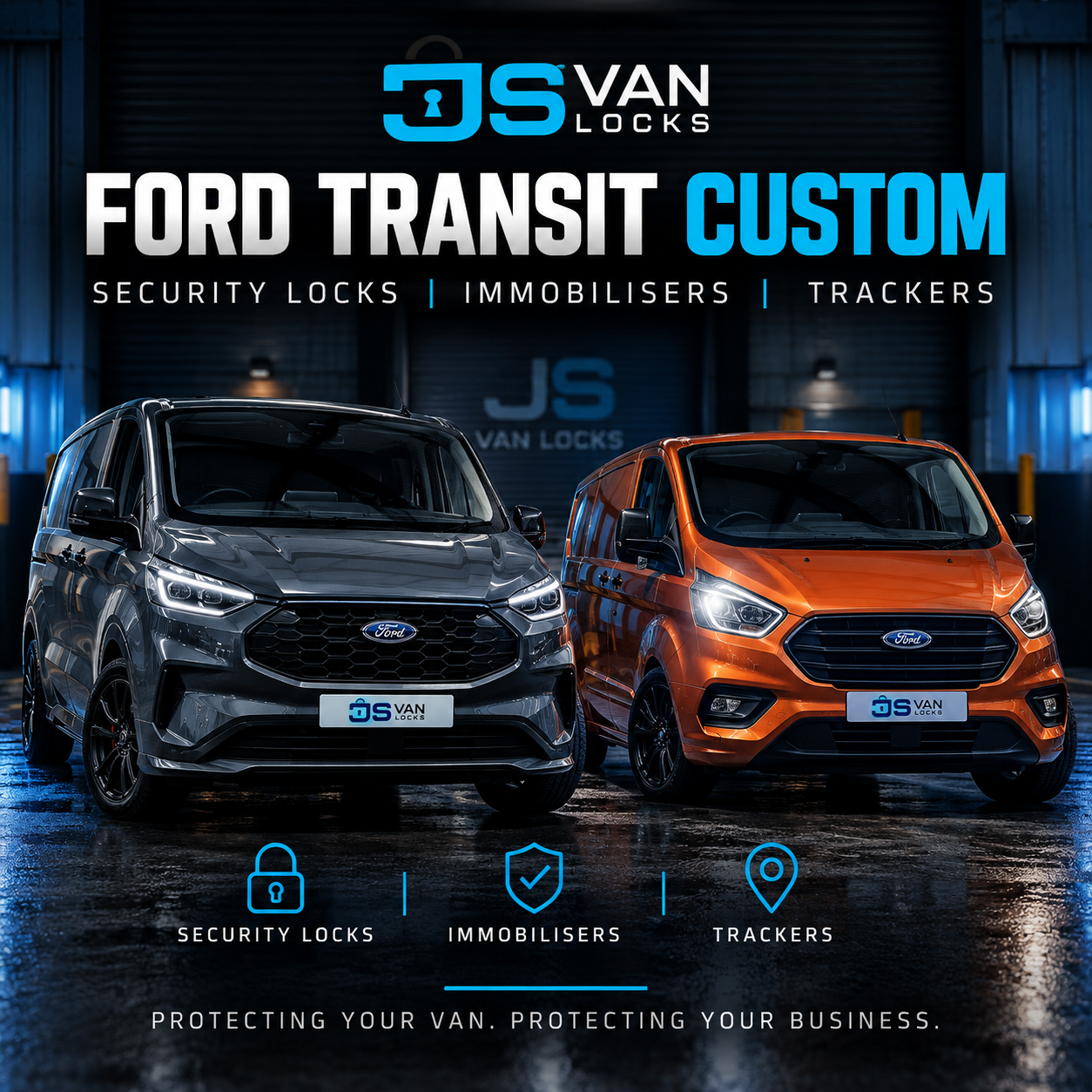
Ford Transit Custom Security: Which Locks and Immobiliser Do You Need?
Updated: Sep 25
If your Ford Transit Custom carries the tools you need to earn a living, security needs to cover more than the van's original door locks.
A sensible setup should make the load area harder to access and add protection against the van itself being driven away. Those are different jobs, so a hooklock, an immobiliser and a tracker are not interchangeable.
At JS Van Locks, our starting point for a tool-carrying Custom is compatible additional load-door locks. We then assess door protection, the driver's lock, immobilisation and tracking around the vehicle and its use. We provide mobile fitting across the Midlands, including Swadlincote, Burton upon Trent, Derby and Tamworth.
Here is how we would approach your van, without selling the same package to every owner.
First, which Transit Custom do you own?
Locks 4 Vans separates its fitment guides into the 2012–2023 Custom and the new-shape Custom, listed as 2023 onwards. A registration year around the changeover is not enough to choose a kit on its own.
Send us your registration and, where needed, a photograph of the van. We also need to know whether it has one or two sliding doors, rear barn doors or a lifting tailgate, windows, and racking or a camper conversion.
The recommendations below are JS Van Locks' installer guidance, not a statistical ranking of theft risk. Product fitment is checked against the exact vehicle before installation. See the manufacturer's older Custom guide and new-shape Custom guide.
Driver's-door attacks on the 2012–2023 Transit Custom: Replock protection
The attack: thieves may target the original driver's-door cylinder by picking or forcing it. The L4V Ford replacement lock is designed to resist picking and forced rotation, with increased resistance to drilling. This addresses the driver's lock, not the separate problem of holes made through loading-door panels.
For this generation, we strongly recommend an L4V Replock as a core part of the security assessment, alongside suitable additional load-door locks. We do not treat the driver's lock as an afterthought simply because the tools are in the back.
A Replock upgrades the original driver's-door cylinder and bezel. It is different from adding an independent hooklock to a loading door, and neither product replaces the other. The L4V replacement-lock specification explains its anti-pick and anti-spin design.

New-shape Transit Custom, 2023 onwards: assess it separately
We do not automatically give the driver's replacement lock the same priority as on the earlier Custom. Our approach is to assess the newer van's specification, existing security and the customer's concerns first, while still prioritising suitable load-area protection for tool carriers.
That does not mean a Replock is unavailable or never worthwhile: L4V lists a replacement lock for this generation too. It means we recommend a package for the actual van, rather than carry an older model's checklist straight across.

Hooklocks, deadlocks or slamlocks: which suits your work?
An L4V hooklock adds a separate mechanical locking point operated with its own key. Its hooked bolt engages with a receiving section, rather than relying on the factory central locking. A conventional deadlock uses a straight bolt instead. See the manufacturer's hooklock and deadlock descriptions.
For an owner-driver carrying tools, compatible hooklocks on the loading doors are normally our starting point. You must actually lock them: a manually operated lock left disengaged cannot provide its intended additional protection.
For a courier making repeated deliveries, we would also discuss slamlocks. These lock automatically when the door closes, addressing a different practical problem: forgetting to relock the loading area between stops. L4V describes this use in its Custom fitment guides. We would explain key management and lockout precautions before choosing that arrangement.
The useful question is not simply which lock is strongest. It is which compatible system you can use reliably, every working day. Explore our van locks and shielding options.


Where should Transit Custom locks be fitted?
High, middle and low positions are not interchangeable. Door construction, glazing, existing equipment and the complete locking kit all matter.
For example, L4V's current new-shape Custom guide recommends a high side-door hooklock and a mid-position rear barn-door hooklock, subject to its fitment restrictions. It marks the high positions as unsuitable for glazed doors and states that the rear mid-position installation is incompatible with its barn-door handle shield. This is why adding every available accessory is not automatically the right answer.
We check the combination before quoting. A lifting tailgate also needs a different assessment from twin barn doors. For compatible tailgate installations, our usual arrangement is two additional locks, one on each side, with the exact kit and clearances confirmed first.
Our guide to high, mid and low van-lock positions explains the principles in more detail.


Door-peeling attacks: hooklocks and anti-peel protection
The attack: a section of a side or rear door is bent or pulled away to create access to the load area, even while the original lock may remain engaged.
What we fit: compatible L4V hooklocks in suitable positions, combined with vehicle-specific anti-peel reinforcement where available. Hooklocks add locking points; anti-peel products reinforce the door against being pulled apart. L4V recommends pairing its side-door anti-peel kit with a suitable high-position hooklock, subject to the van's fitment restrictions.
Side doors and rear barn doors need separate assessment. L4V also lists a dedicated barn-door anti-peel solution for the earlier Custom. We do not assume that kit fits the newer generation or a lifting tailgate. We check door construction, glazing and existing locks before choosing the combination.
Drilling or puncturing the outer skins of side and rear doors
The attack: holes may be drilled or punctured through a door's outer metal skin to reach the factory latch or release mechanism and attempt to open the door. This is different from attacking the visible key cylinder. Both side-loading doors and rear-door mechanisms need to be considered, with the vulnerable components differing by generation and door design.
What we fit: compatible internal latch shields and anti-drill protection for the relevant doors, alongside independent load-door hooklocks. The L4V shielding range protects selected mechanisms against access through the bodywork. An engaged hooklock adds another locking point if the factory release mechanism is compromised; it does not make the outer door skin drill-proof.
The exact kit matters. L4V's new-shape Custom guide lists combined external shields and drill-resistant internal plates for the sliding doors, and separate internal latch shields for the barn doors. Those are different products, not one universal plate for every door.
At JS Van Locks, we favour suitable internal protection where it provides the required defence. External shields are particularly useful when covering previous attack damage or when the correct vehicle-specific kit requires an external component. Tell us about existing damage and repairs so we can assess the door before recommending the work.
Shields and hooklocks protect different parts of the door, so we assess them together. No combination can guarantee a damage-free attempted break-in, but the aim is to make access harder rather than leave the factory latch as the only barrier.
Does a Transit Custom need an additional immobiliser?
Hooklocks help protect access to the loading area. An additional immobiliser is intended to prevent unauthorised starting or driving, subject to the system and installation. It does not physically lock the doors or protect loose tools by itself.
We would discuss immobiliser installation whenever keeping the whole van is a priority. An older working Custom can be just as important to its owner as a newer MS-RT, so we do not dismiss additional protection purely because a van is worth less on paper.
MetaTrak AutoBlock: standalone immobilisation
The MetaTrak AutoBlock is an option we offer for tag-based immobilisation where suitable. It is a standalone immobiliser, not a tracker, and the standalone system does not provide vehicle tracking or app control.
It is a different purchase from a monitored tracking package. We confirm the configuration and compatibility for your particular Custom before recommending it.
MetaTrak S5 Deadlock: tracking with immobilisation
The MetaTrak S5 Deadlock combines Category S5 stolen-vehicle tracking, driver recognition and immobilisation. MetaTrak describes tag-based authorisation, remote Deadlock functionality, app-based vehicle information and 24/7 stolen-vehicle support in its cars and vans security range.
Despite the name, S5 Deadlock is an electronic security system, not a mechanical door deadlock. It does not replace load-door hooklocks.
Read our MetaTrak S5 Deadlock guide for a fuller explanation. Tracking services have subscription requirements; ask us to confirm the current package and ongoing costs. Where your insurer specifies a tracker, get confirmation that the particular system and installation meet the policy's requirements.
We also recommend keeping an authorisation tag separate from the vehicle keys. If both are stolen together, the thief may have the separate authorisation you intended to keep out of their hands.
No security package can guarantee that a van will never be stolen. Immobilisation does not physically prevent it being lifted or transported, which is one reason vehicle tracking may form part of a wider plan.
For an example of these security layers working together, see our Ford Transit security installation in Leicester. This case study features a full-size 2026 Transit, not a Transit Custom; the products and fitting positions were assessed for that vehicle.
What would we prioritise for your Custom?
These are starting points for a conversation, not fixed-price packages or universal fitment promises.
Working van carrying tools: compatible additional locks for each loading door, then appropriate anti-peel and shielding protection. On a 2012–2023 Custom, include the driver's Replock in the core assessment. Discuss immobilisation for whole-vehicle protection.
Delivery van or fleet: choose a locking routine that suits frequent access and multiple drivers. Consider automatic locking where appropriate, key management, existing equipment and how installation can fit around work.
Camper or leisure conversion: assess the living area, glazing and whether there is a solid bulkhead. Without one, we give cab-door security greater attention. Any locks used while people are inside must preserve a quick, safe escape route; do not secure occupants behind external-key-only locks.
A diesel, plug-in hybrid or electric Custom also needs the right installation approach. Compatibility with one version is not proof of compatibility with every powertrain, trim or conversion.
How much does Transit Custom security cost to fit?
The fitted cost depends on your door layout, the number and type of locks, the required shields, existing equipment and the electronic security selected. Access behind racking or conversion panels may also affect the work.
Rather than publish a misleading one-price-fits-all figure, we quote for your actual van. Ask for a breakdown showing the products, fitting, any applicable VAT or travel charges, and any ongoing tracking subscription.
A cheaper-looking quote may cover fewer doors or a different combination of products. Compare what is included, not just the total. We can prioritise the work around your budget without pretending that an omitted layer is already covered.
Frequently asked questions
Can the additional locks use the same key?
Compatible L4V products can be supplied keyed alike. Tell us about any existing L4V key system before we order parts, so we can confirm what is possible. Keep your key records securely, rather than posting key numbers or security cards online.
Can you work around racking or a camper conversion?
Send photographs of the relevant doors and interior panels before booking. We will assess access and explain whether anything needs moving. We will not assume that a lock position suitable for an empty panel van also suits a converted one.
What about a leased or company-owned van?
Check with the vehicle owner or lease provider before authorising modifications. We can explain the proposed work so you can obtain the permissions you need. Do not assume that every modification is automatically acceptable under every contract.
Is it worth upgrading an older Custom?
Our recommendation is based on what you need to protect and how much you rely on the vehicle, not its age alone. Tools, missed work and disruption still matter in an older van. We would assess it properly rather than remove useful protection from the recommendation just because of its registration year.
Mobile Transit Custom security fitting across the Midlands
JS Van Locks provides mobile van-security installation at suitable homes, workplaces and fleet premises. We cover Swadlincote, Burton upon Trent, Derby, Tamworth and surrounding Midlands areas, with other locations considered when arranging the job.
For a quote, send your registration, fitting postcode, door layout, existing security and what you need to protect. Photos of the van and loading doors help us identify the right configuration, especially around the model changeover or on converted vehicles.
Contact JS Van Locks about your Transit Custom and we will help you choose a suitable combination of locks, shielding, immobilisation and tracking.
For the wider picture, read our Midlands van and vehicle security guide.
Product information checked in September 2026. Manufacturer references are linked beside the relevant advice. Availability and fitment can change, so the final specification is confirmed for the individual vehicle before booking.


Comments